We looked back to where Jersey must be. Indeed we could just see under the cloud the line of the coast floating on the waters. It slid away and disappeared. We saw another line glowing in the darkness ahead... It was Guernsey! ... against the raging sea our steamer forged ahead, and an hour or so later slowed up, and then halted, in front of a faery like town, picturesquely staged up steep hill slopes... With its old Norman Roofs, with the proud Gallic cock on its church spire, Saint Pierre Port has indeed an air of home for us French refugees, which is indeed irresistible. The very name is a Welcome; remember that Saint Peter keeps the doors of Paradise!
Now all my father's precious manuscripts were in one huge trunk which he could not bear to let out of his sight. In the kind of weather we were suffering it was a terrible decision, that of entrusting all these unpublished masterpieces to a little cockle shell of a boat... Father had to decide to gamble twenty years of work and hand it over to the caprice of the waves. He took that chance.
And we climbed down to the boat that waited at the foot of the gangway, swinging ten foot up to us and ten foot away from us with each wave. Two burly matlows slung the trunk carelessly down, and perched it on the bows of the boat, with no more concern that they would have done with a bale of cotton or a basket of cod.
It was dreadful--for some minutes the trunk wobbled on the breakers... I could see the Contemplations disappearing under ten foot of water. But luckily there is a Providence which watches over Poets. Though the storm raged fiercely, more fiercely than ever, we landed safely on the quay.
Friday, August 6, 2010
Victor Hugo arrives at Guernsey
The Expulsion of Victor Hugo, by Jean Le Pelley, which originally appeared in the Transactions of La Society Guernesaise for 1970. Contains this glimpse into Victor Hugo's arrival on Guernsey during a storm. I love this portrayal of the great man's trunk with all his writings being in such jeopardy. In this description Le Pelly quotes Victor Hugo's son, François-Victor Hugo (known as Tòto) who wrote an account called Normandie Inconnue.

Tuesday, July 13, 2010
Launching 'A Guernsey Double'
Back from Guernsey now after a very successful launch of A Guernsey Double, the publication of which was supported by the Guernsey Arts Commission. Perhaps most enjoyably we managed to get on BBC Guernsey with Jenny Kendall-Tobias twice. She's an excellent radio host and a lovely woman, and we did an entire two hour show with her. What we couldn't have predicted was that she would love our work so much.
The book launch itself was great fun too, and we were introduced by Jane Mosse who did a perfect job, and the event was hosted in The Greenhouse in St Peter Port which is a wonderful venue above the tourist information building - and we signed dozens of books right away. There is a buzz about seeing your book in a shop window, in this case The Guernsey Press shop, where we did a signing the next day.
The only blank we got was from The Guernsey Press itself, who appear to have little interest in a burgeoning literary scene that's right under its nose.
Online, a the first edition of A Guernsey Double is currently available from anthologyofguernsey.com -- and before too long it will be on Amazon too.
Below Richard and JKT in our first BBC interview, me in reception, a book display.


The book launch itself was great fun too, and we were introduced by Jane Mosse who did a perfect job, and the event was hosted in The Greenhouse in St Peter Port which is a wonderful venue above the tourist information building - and we signed dozens of books right away. There is a buzz about seeing your book in a shop window, in this case The Guernsey Press shop, where we did a signing the next day.
The only blank we got was from The Guernsey Press itself, who appear to have little interest in a burgeoning literary scene that's right under its nose.
Online, a the first edition of A Guernsey Double is currently available from anthologyofguernsey.com -- and before too long it will be on Amazon too.
Below Richard and JKT in our first BBC interview, me in reception, a book display.


Monday, June 7, 2010
A Guernsey Double -- official launch
Have been somewhat diverted from working on the Anthology due to the fact that Richard Fleming and I have now finalised the contents of A Guernsey Double, our two person collection of poetry about Guernsey. The book is in two halves, my bit is called The Boy Who Fell Upwards, and Richard's The Man Who Landed.
The launch for this will fittingly be in St Peter Port on July 1st 2010, in the Greenhouse at 5:30. Every poem in the collection is directly related to the island, and Guernsey very much is the star of the collection.
We were lucky enough to get Professor Edward Chaney to write us a generous introduction, in which he says:
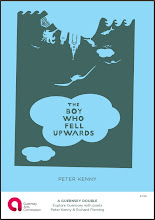
Below, the double fronted cover, designed by Betsy Alvarez the barcode and isbn to be dropped into the bottom right hand corner.


The launch for this will fittingly be in St Peter Port on July 1st 2010, in the Greenhouse at 5:30. Every poem in the collection is directly related to the island, and Guernsey very much is the star of the collection.
We were lucky enough to get Professor Edward Chaney to write us a generous introduction, in which he says:
"Not since the extraordinarily poetic Book of Ebenezer le Page has a single volume made the soul of the island so unremittingly its focus. The results are powerfully moving: a work that deals with both losing a home and finding one. Two sides of the same coin. For Guernsey people, or visitors, this book is a rich addition to their experience of the island."Naturally Richard and I looking forward to this a great deal. The book is a double fronted concept, which has two front covers. The name A Guernsey Double derives from the fact that there are two poets in it, is that doubles were coins, which were still legal tender into 1960s. However Jane Mosse has also been very involved, not least in proofing and editing. Without her help, for example, patois might have appeared (disastrously) as patios in the text.
Below, the double fronted cover, designed by Betsy Alvarez the barcode and isbn to be dropped into the bottom right hand corner.


Sunday, June 6, 2010
Celia Jenkins
Have been contacted by Celia Jenkins, who is currently studying Creative Writing, and writing about Guernsey. Here is one of her poems...
An Introduction to the Island of Guernsey, with interludes of Patois
What can I say of a local girl?
Well it’s clear al a la langue bian pendue.
(That’s having the gift of the gab, by the way)
Or maybe al est natte troubllaie.
(She’s completely mad? Most likely)
It’s not hard to see that we local folk are of one ilk,
kindred since our day of birth.
From the Neolithic Guerns who sculpted our dolmens,
to the current dwellers on Sarnia,
(yes, that same one from Sarnia Cherie, all together now...)
We are tied by traditions and traits alike.
Ask a Guern a tchi qu'vous navidgai?
and they’ll likely reply that they’re off to milk the Guernsey cows,
or plant more tomato crops.
We the people, crew crowd and kind,
alike in our fishermen’s knitted jerseys
and jaunty berets,
born and bred a fellowship
to a club, a sort who understand our culture and pride,
these things that make us who we are:
Victor Hugo, liberation, lilies, ormers,
bean jar and gauche from the Viaer Marchi,
the little chapel, phone booths and post boxes painted in blue.
We are a band, a gang,
blood, stock and house,
connected by lineage and familiar soil,
our gem of the sea.
A la perchione.
An Introduction to the Island of Guernsey, with interludes of Patois
What can I say of a local girl?
Well it’s clear al a la langue bian pendue.
(That’s having the gift of the gab, by the way)
Or maybe al est natte troubllaie.
(She’s completely mad? Most likely)
It’s not hard to see that we local folk are of one ilk,
kindred since our day of birth.
From the Neolithic Guerns who sculpted our dolmens,
to the current dwellers on Sarnia,
(yes, that same one from Sarnia Cherie, all together now...)
We are tied by traditions and traits alike.
Ask a Guern a tchi qu'vous navidgai?
and they’ll likely reply that they’re off to milk the Guernsey cows,
or plant more tomato crops.
We the people, crew crowd and kind,
alike in our fishermen’s knitted jerseys
and jaunty berets,
born and bred a fellowship
to a club, a sort who understand our culture and pride,
these things that make us who we are:
Victor Hugo, liberation, lilies, ormers,
bean jar and gauche from the Viaer Marchi,
the little chapel, phone booths and post boxes painted in blue.
We are a band, a gang,
blood, stock and house,
connected by lineage and familiar soil,
our gem of the sea.
A la perchione.
Friday, June 4, 2010
Sam Thompson
Sam is one of those writers who has fallen under the spell of Guernsey, and has sent me some of his work. I am really delighted that lately more and more writers with a Guernsey connection are becoming interested in the Anthology.
Here is an extract from Ste Marguerite de la Forêt (2006) is the penultimate poem in a sequence of 15 free verse sonnets entitled Church Poems depicting the churches which have featured prominently in his life.
From Guernsey’s rugged south coast cliffs
the Forest parish
Climbs through lanes where sunlight
catches a stream or douit
And crosses the fields of the high plateau.
Here a tower and spire
Rise beside the jumbled houses of Le Bourg:
its walls a jigsaw
Of granite slabs, its cornerstones
once part of a dolmen,
With grass and graves on all sides the church stands
alone in its own walled garden.
Here is an extract from Ste Marguerite de la Forêt (2006) is the penultimate poem in a sequence of 15 free verse sonnets entitled Church Poems depicting the churches which have featured prominently in his life.
From Guernsey’s rugged south coast cliffs
the Forest parish
Climbs through lanes where sunlight
catches a stream or douit
And crosses the fields of the high plateau.
Here a tower and spire
Rise beside the jumbled houses of Le Bourg:
its walls a jigsaw
Of granite slabs, its cornerstones
once part of a dolmen,
With grass and graves on all sides the church stands
alone in its own walled garden.
Monday, March 29, 2010
The Toad and the Donkey
Interesting email from Geraint Jennings from Jersey letting me know about the forthcoming book "The Toad and the Donkey" which he is editing with Jan Marquis.
Click here for more news about their forthcoming book. Meanwhile here is an excellent poem in Channel Island French by Geraint, and its translation below.
À ces sé
La lueu du rêsèrveux blyînque blianche au bliu du sé;
lé couochant lanche des pétales d'rose sus les côtis.
Du haut du mont jé d'vale – l'alanchie dans l'èrfliet
d'la mathe tchi m'fliatte atout eune fliotte dé caûques-souôthis.
Et j'pâsse par des fôssés endgèrrués en nièr,
entouortilyis dé veîl'yes dé r'lié et d'amèrdoux.
Les rêvacheurs d'la niet en vithevardant d'travèrs
ont voltilyi par 'chîn, par là – des vielles d'avoût.
La batt'tie d'ches néthes ailes a libéthé man tchoeu:
rôdant les c'mîns à la r'vèrdie, j'touônne en ouéthou.
Les pétales sont pouôrries et n'yées dans la nièrcheu;
les caûques-souothis ont chuchi l'rouoge d'la séthée d'v'lous.
Tout veint à fîn: un jour, un c'mîn, un tchoeu tchi bat,
les dreines lueuthes d'eune séthée, man soûffl'ye et man suffat.
This evening
The light of the reservoir blinks white in the blue of the evening;
the sunset throws rose petals on the côtils.
From the top of the hill I descend – diving into the reflection
of the pool which caresses me with a flock of bats.
And I pass by the hedgerows overgrown blackly with ivy,
entwined with field bindweed and woody nightshade.
The dreamers of the night zigzagging across my path
have fluttered here and there – summer whirlwinds.
The beating of these black wings has freed my heart:
roaming the roads at dusk, I turn into a shapeshifting spirit.
The petals are rotten and drowned in the darkness;
the bats have sucked the red from the velvet evening.
Everything comes to an end: a day, a road, a beating heart,
the last tatters of an evening, my breath and my burden.
Click here for more news about their forthcoming book. Meanwhile here is an excellent poem in Channel Island French by Geraint, and its translation below.
À ces sé
La lueu du rêsèrveux blyînque blianche au bliu du sé;
lé couochant lanche des pétales d'rose sus les côtis.
Du haut du mont jé d'vale – l'alanchie dans l'èrfliet
d'la mathe tchi m'fliatte atout eune fliotte dé caûques-souôthis.
Et j'pâsse par des fôssés endgèrrués en nièr,
entouortilyis dé veîl'yes dé r'lié et d'amèrdoux.
Les rêvacheurs d'la niet en vithevardant d'travèrs
ont voltilyi par 'chîn, par là – des vielles d'avoût.
La batt'tie d'ches néthes ailes a libéthé man tchoeu:
rôdant les c'mîns à la r'vèrdie, j'touônne en ouéthou.
Les pétales sont pouôrries et n'yées dans la nièrcheu;
les caûques-souothis ont chuchi l'rouoge d'la séthée d'v'lous.
Tout veint à fîn: un jour, un c'mîn, un tchoeu tchi bat,
les dreines lueuthes d'eune séthée, man soûffl'ye et man suffat.
This evening
The light of the reservoir blinks white in the blue of the evening;
the sunset throws rose petals on the côtils.
From the top of the hill I descend – diving into the reflection
of the pool which caresses me with a flock of bats.
And I pass by the hedgerows overgrown blackly with ivy,
entwined with field bindweed and woody nightshade.
The dreamers of the night zigzagging across my path
have fluttered here and there – summer whirlwinds.
The beating of these black wings has freed my heart:
roaming the roads at dusk, I turn into a shapeshifting spirit.
The petals are rotten and drowned in the darkness;
the bats have sucked the red from the velvet evening.
Everything comes to an end: a day, a road, a beating heart,
the last tatters of an evening, my breath and my burden.
Tuesday, February 2, 2010
Denys Corbet
Richard Fleming and myself went to visit Joan Ozanne who is a mine of local information about local culture. She showed us an old book called Les Feuilles de la Foret/Les Fieilles d’la Fouarêt/ The Leaves of the Forest) by Denys Corbet, published in 1891. Richard and I had a quick thumb through, and there was some interesting content.
Wikipedia has some useful information on Denys Corbet giving his dates as 22 May 1826 – 21 April 1909). Corbet described himself as the Le Draïn Rimeux (The Last Poet). He is best known for his poems, especially the epic L'Touar de Guernesy, a picaresque tour of the parishes of Guernsey and Les Feuilles de la Foret (The Leaves of the Forest) among others. Contemporary Canadian artist Christian Corbet is a cousin of Denys Corbet. A forthcoming biography by Christian Corbet is currently being written.
Also this new site The Official Website of Denys Corbet appears to be being created.
Corbet wrote in Guernsey French, French and English - rather like Métivier, his older contemporary.
Here is the opening to an amusing poem called Beards.
Wikipedia has some useful information on Denys Corbet giving his dates as 22 May 1826 – 21 April 1909). Corbet described himself as the Le Draïn Rimeux (The Last Poet). He is best known for his poems, especially the epic L'Touar de Guernesy, a picaresque tour of the parishes of Guernsey and Les Feuilles de la Foret (The Leaves of the Forest) among others. Contemporary Canadian artist Christian Corbet is a cousin of Denys Corbet. A forthcoming biography by Christian Corbet is currently being written.
Also this new site The Official Website of Denys Corbet appears to be being created.
Corbet wrote in Guernsey French, French and English - rather like Métivier, his older contemporary.
Here is the opening to an amusing poem called Beards.
Ho! all ye sons of froth and smoke,
Who daily to the eyes must soak
In reeking lather that might choke
Old Nick, thus smeared :
Come, hear me sing, ye smooth chinned folk
My theme's the beard.
All ye who every morning mow
Crops that have no time to grow
Bid you but once the luxury know
Shown in my lyric,
You would your strops and razors throw
Where th'wise threw physic.
We children of the good old school,
Observing Nature's every rule,
Wear a long beard to keep us cool
In summer season,
And warm in winter--where's the fool
Can better reason?
Subscribe to:
Posts (Atom)